The Importance of Helping Young People Navigate Climate Emotions
This year’s UN Climate Report delivered a bleak reality check: Our efforts to reduce greenhouse gas emissions will not keep us from surpassing the 1.5°C global average temperature limit. The report, titled “Limiting Overshoot - Navigating exceedance of 1.5°C and pathways towards return”, warns of more frequent and more severe climate events that we are already seeing around the world: wildfires, coral reef collapse, glacial and ice sheet melting, and other disasters.
In response, the report calls for faster mitigation and adaptation to our evolving climate reality, both of which can help us build resilience and keep cutting emissions. But before we can take climate action, let’s pause and take stock of our climate emotions—how we feel about the climate crisis and what sensations arise when we think about a positive climate news story versus a negative one.
Processing climate emotions, especially for children and teenagers, helps us validate and work through what we’re feeling and gives us the best chance to build resilience at both the individual and community levels. Below, we’ll unpack research on these emotions—including one of the most prevalent, climate anxiety—and share top strategies for parents and educators to help young people face the climate crisis.
An Overview of Climate Emotions: Why Naming Our Feelings Helps Us Process
Climate emotions is a growing field of research that describes the range of people’s feelings and reactions to the climate crisis. In a 2022 research article, Panu Pihkala combined twenty-first-century literature reviews and research on climate emotions to develop a taxonomy. The goal was not only to understand people’s climate feelings but also to see if those emotions could be channeled into proactive climate action.
Based on Pihkala’s research, and with his permission, climate journalist Anya Kamenetz and the Climate Mental Health Network created the Climate Emotions Wheel. The inner wheel groups climate emotions into four core categories—anger, sadness, fear, and positivity—while the outer wheel shows offshoots of those core emotions—for example, anger has indignation, outrage, frustration, betrayal, and disappointment.
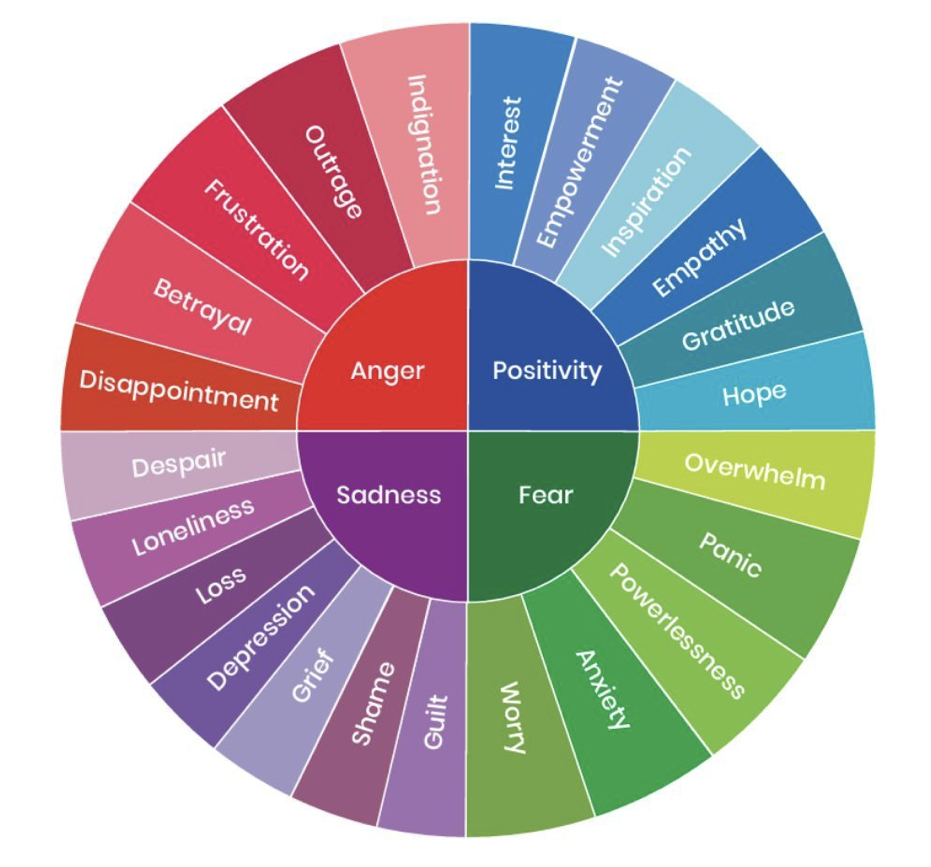
Source: Climate Mental Health Network
While positive emotions like hope and empathy appear in literature reviews, negative climate emotions receive broader attention and a wider range of focus. According to the Climate Mental Health Network website, “Research suggests that simply recognizing and labeling a negative emotion, such as anxiety or fear, can reduce its intensity.”
Without this “Name It to Tame It” approach that psychiatrist and author Daniel Siegel coined, many people end up with maladaptive coping strategies that can keep them stuck in negative emotions. This is particularly true of children dealing with climate anxiety.
Climate Anxiety and Its Effects on Children
One of the more prevalent climate emotions, climate anxiety specifically refers to anxiety related to the environmental impacts of climate change. It’s experienced globally and across generations. In 2025, the American Psychiatric Association published new data that showed more than 40% of adults experienced effects on their mental health due to climate change. Likewise, about one-third of adults (35%) reported worrying about climate change weekly.
Because children are still developing cognitive functions, including emotional regulation, they are even more vulnerable to climate-related mental health effects. According to a 2021 study published in The Lancet, researchers interviewed 10,000 children and young people ages 16–25 in 10 countries about their feelings about climate change:
59% of respondents were “very or extremely worried”
84% were at least “moderately worried”
75% agreed with the statement “the future is frightening”
Ariella Cook-Shonkoff—a licensed psychotherapist, registered art therapist, and author of Raising Anti-Doomers: How to Bring Up Resilient Kids Through Climate Change and Tumultuous Times—sees this worry in both her patients and everyday life. “Across all age groups, I hear examples of what is called ‘moral injury’—the distress that arises when a person's moral beliefs are violated,” she told Earth Matters. “Some teens express that it's incomprehensible that adults aren't doing more to prevent climate breakdown. They feel confused, fearful, betrayed, angry, sad.”
Consider these feelings on top of everything else that may stress a child: schoolwork, family dynamics, smartphone use, social life, getting sick. Strong, pervasive climate emotions can disrupt other areas of a child’s life. “I understand how immobilizing these emotions can be,” said Cook-Shonkoff, “and it's critical to support people in moving through rather than staying stuck in them.”
Helping young people navigate climate emotions starts with validating them. In an article published by Harvard Medicine, child and adolescent psychiatrist Elizabeth Pinsky noted how anxiety is commonly approached as something that needs treatment. “But it’s also a constructive emotion that gives us time to react in the face of danger,” she said. “And anxiety in the face of climate change is a healthy response to a real threat.”
How to Help Kids Become More Climate Resilient: Tips for Parents and Educators

Climate emotions in children offer useful guidance for parents and educators who want to help them understand the natural world and their role in it. Instead of viewing climate anxiety and other negative emotions as problems to solve, see them as opportunities to gather, talk, and connect.
Here are some targeted tips for parents and educators when talking to and working with kids.
Communication
Talking about the climate crisis is difficult no matter how old the conversationalists are. When it comes to conversations with kids, most adults face a common dilemma: they don't want to lie, but they also don't want to overwhelm them. Ariella Cook-Shonkoff has some strategies that can help.
Top Parent Tip
“When having a conversation, go slow, be curious, and find what I call ‘the goldilocks porridge’ that's right for your child—not too doomer but not total denial either,” said Cook-Shonkoff. “What you want to avoid as much as possible is too much information, too soon, too fast.”
She advises thinking beyond a one-off conversation, recognizing that many conversations will follow and incrementally help kids become more familiar with difficult climate topics. “These conversations set the groundwork for future conversations because they invite curiosity, vulnerability and emotions-sharing.”
Top Educator Tip
In the classroom, Cook-Shonkoff encourages teachers to introduce the three V’s: voice, validate, and vision. “Voice means creating a safe place for kids to speak their truth. Validate means to listen without judgment, and reflect back what you've heard. And Vision means being a young person's ally in moving towards action and support. Kids are naturally action-oriented, so channeling emotions into action is a good fit!”
Action and Advocacy
Climate action looks different across age groups and individuals. Children should understand they aren't expected to single-handedly save the world and solve every environmental problem. Rather, adults in their lives can present opportunities for age-appropriate, small-scale action and advocacy.
In an interview in Yale Sustainability, clinical psychologist and associate professor Dr. Sarah Lowe discussed how individual and collective action can challenge climate anxiety. “I think theoretically there is a difference between, for example, showing up at a single protest with a couple of friends versus being engaged in a longer-term effort where you’re working with other people, establishing relationships, and you can see the fruits of your hard work in terms of policy changes,” she said. “I would imagine that sustained engagement in a cause could be beneficial.”
Beach cleanups, community gardens, and peaceful protests are all forms of collective action that promote social wellbeing, strengthen community climate resilience, and ward off negative climate emotions.
Even simple outdoor activities can evoke positive climate emotions. Cook-Shonkoff witnesses this at the park and nature reserve across from her home:
“I see kids climbing trees, splashing in creek water, watch parents hiking with babies on their backs and huge smiles on their faces, see many young people walking their dogs and taking in the fresh air, and older adults hiking in the hills with poles. I love to observe the emotions etched in their faces: awe, gratitude, wonder, excitement, playfulness, joy, aliveness, empathy, and care.”
Emotional Wellbeing
As an adult, having emotional and mental check-ins with kids is important so you know how they’re doing and they can recognize what they’re feeling. While discussing collection action, Dr. Lowe added, “[at] the same time, individuals should exercise self-awareness to know whether they are burned out and to try to engage with those feelings.”
Top Parent Tip
Before turning to your child’s climate emotions, Cook-Shonkoff advises you to consider your own:
“Anxiety, doomerism and depressive emotions trickle down from grownups to kids, so it's important to find your own support, so that you can be vulnerable with your feelings and not burden your kids with them (whether that's with a friend or group or professional).”
Top Educator Tip
Educators who can incorporate climate emotions into their curriculum can frame emotions as an opportunity rather than a source of shame.
“Emotions are proof that we are paying attention, and that we feel deeply as humans,” Cook-Shonkoff said. “It can be a helpful exercise to simply color in a mandala (or circle) with feelings about climate change. Not only is art-making soothing, but it generates something tangible to talk about and learn from.”